
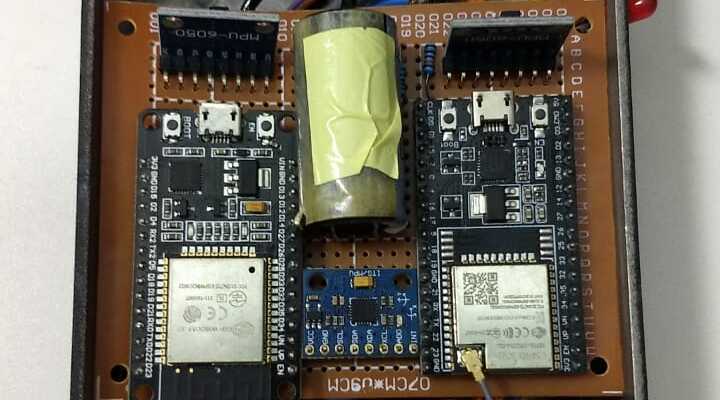
Computer science | Developed during Master’s training, the device warns others as soon as it detects that the wearer fell, expediting rescue to the victim.
*Photo: João Carlos Britto Filho/ Personal Archive
*By Geovana Benites / August 11th 2022
A master’s dissertation defended in the Graduate Program in Microelectronics (PGMICRO) at UFRGS elaborated the prototype of a wearable device able to identify a person’s fall and transmit a warning so they can be helped as soon as possible. Created by João Carlos Britto Filho, the device can be utilized in geriatric hospitals providing greater security to the elderly who suffer more from the consequences of falls. Besides, the device can be used in the home – by elderly people who live alone or people who tend to get dizzy – and in general clinics, to aid patients that have a bigger risk of imbalance.
Even though falls are not only linked to getting older, they are very common among the elderly. According to the project, falling is the fifth most common cause of death and one of the main reasons of elderly hospitalization. According to the National Institute of Traumatology and Orthopedics, one out of every three people over 65 suffers at least one fall. In Brazil, around 20% of deaths among the elderly are due to accidents like that. Head trauma, generally caused by a fall, is the most lethal and incapacitating injury in the world.
The idea for the device came from a personal situation in João’s life, who had a family member who experienced a fall: his grandpa passed away after falling. “I was talking to my supervisor about that traumatic experience and how that bothered me to this date and he immediately said ‘yes’ (to the project),” tells João. The master’s dissertation was advised by professor Marcelo Soares Lubaszewski.
Secure and fault tolerant
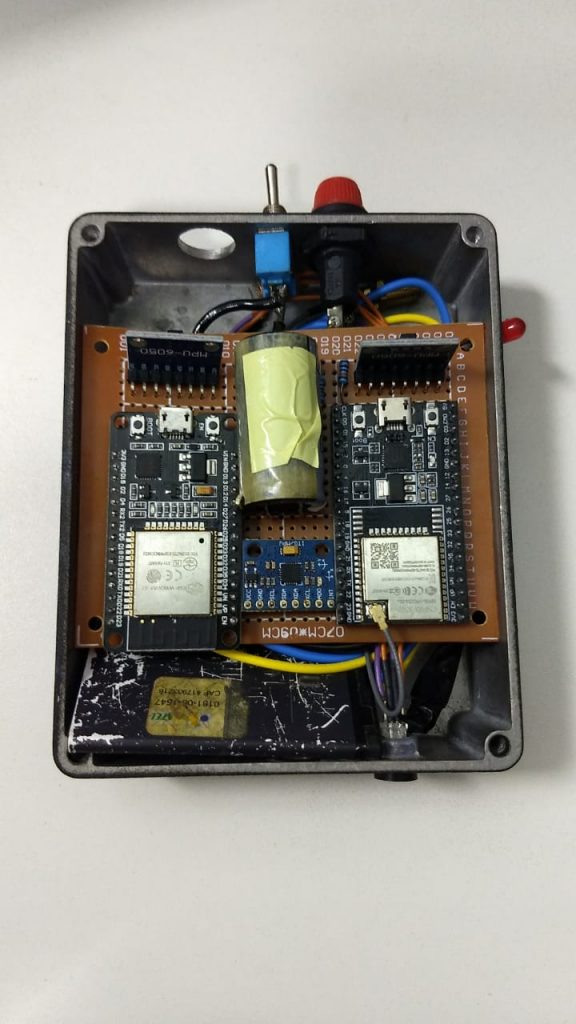
A simple device that needs only three elements to work: a sensor, a processor and some external communication component that warns other people in case of a fall. According to the researcher, there are currently several devices that detect these accidents, but none addresses fault tolerance, clearly showing its capabilities in terms of testing and operating safety. “What happens to some smartphone-based devices is that if the phone stops working or crashes, the time it takes to restart is usually huge, mainly if compared to the time of a fall, which takes about a second and a half,” he explains.
The work, then, tried to focus on this gap, which is not filled in the literature or in the solutions that currently exist. “we have tripled the number of sensors, quadrupled the number of cores (processor element) and doubled the communication element with the cloud. The routes between the processors and the sensors were duplicated as well, so it was an extremely secure and fault-tolerant system.”
In practice, the device can be used with a belt – as it was used during the tests – in any position in the belly region. When the person falls, the device takes three measurements from three distinct angles to confirm that the fall has actually occurred. To arrive at this result, a machine learning algorithm (commands) was used, one that instructs which angles are needed at that particular moment in time when the fall occurred. “For example, the person experiences dizziness, arrives at a boundary angle and, from there forward, the device takes three measurements until the fall occurs and such measurements were defined with the machine learning algorithm,” adds João.
The detector sends warnings the moment the fall begins, that is, just before the person suffers the impact. João explains that, at this point, the system’s biggest energy spike occurs, because it turns on the two processors, connects them to the house’s Wi-Fi network and, about 200 to 300 milliseconds before the person actually falls, the device warns three different servers – which can be directed to family members, neighbors or the person’s health plan. One of the ideas is to include home automation in the process: “It would also be very interesting if the person had an automated system to open the door and call the neighbor, or to make a call to the neighbor, for example”. As the hardware and software are freely accessible, the programming is free for replication through the GitHub site.
According to João, the device can have a direct impact on the reduction of deaths among the elderly due to falls that injure or even incapacitate the individual if help is not provided quickly. “I find it very interesting to use it both in a geriatric hospital and in different hospitals. Sometimes the patient is a little sedated, falls, and until someone arrives, it takes a while, because [the person] cannot notify. The use of this device would be a helping hand for faster rescue and care,” he concludes.
Translated into English by Ana Clara C. Bueno, undergraduate student enrolled in the course “Supervised Translation Training II (English)” of the Undergraduate Program in Language and Literature, under the supervision and translation revision of Professor Elizamari R. Becker (P.h.D.) – IL/UFRGS.
:: Read in Portuguese
Pesquisador da UFRGS cria dispositivo vestível que detecta quedas