
Citizen science | By combining technology, volunteer work and researchers work, this format allows a wide mapping of information in large areas. Thus, it’s possible to combine non-scholarly work with conventional research to map the geographic distribution of species, such as the endangered vinaceous-breasted parrot
*By Elstor Hanzen
*First published July 27, 2023
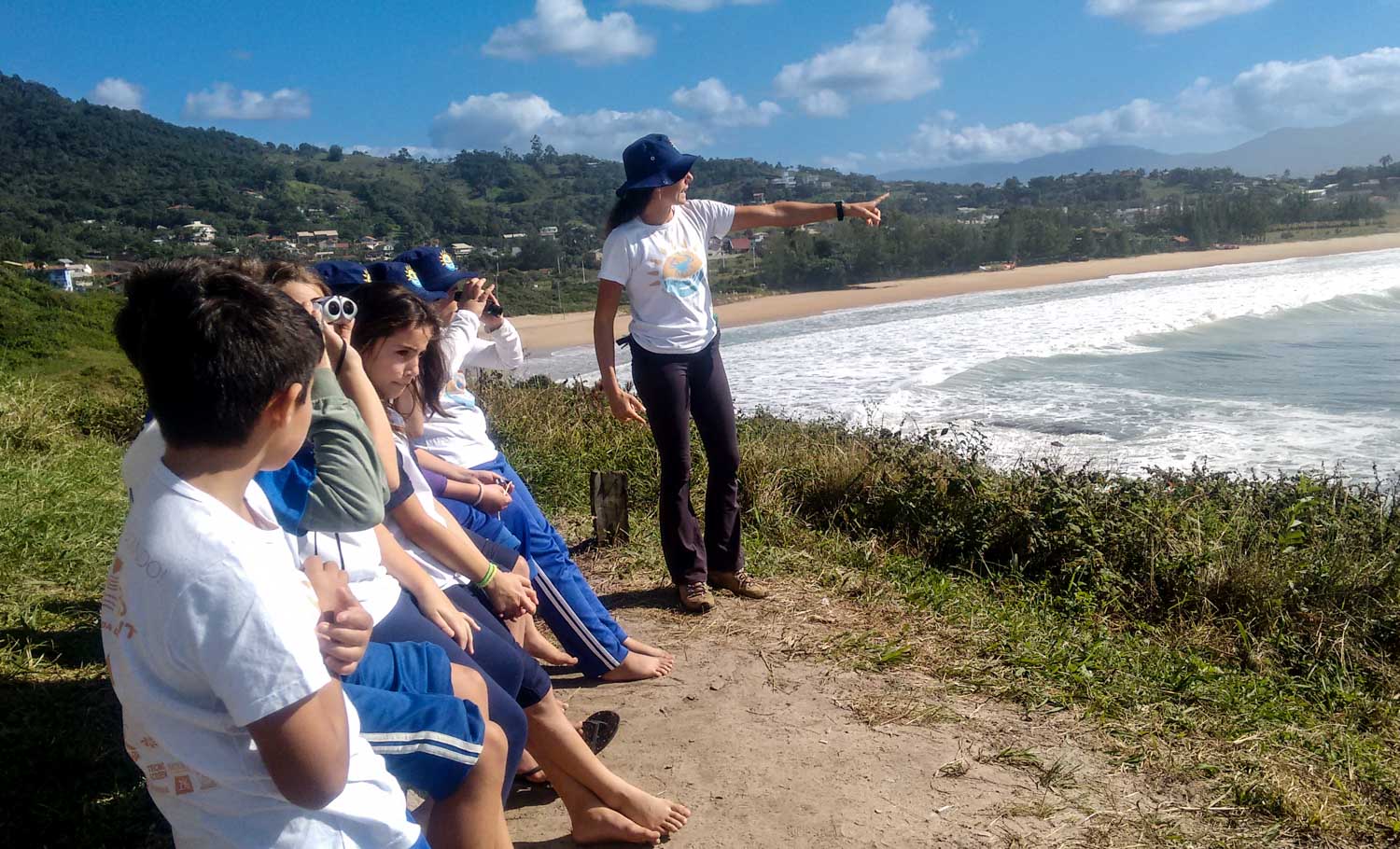
*Image: Explanation during the sighting of a Right whale during an activity organized by the Junior Coastal Monitoring Institute (IMMC), in Garopaba/SC (Cris Guimarães)
Is it possible – among a sample of 47.240 species – to map more than a thousand endangered species of birds in three countries, involving a territory of 2.449.757 km2 that would fit approximately 10 states of the size of Rio Grande do Sul, divided in 3.701 cities? This is the scenario of the research on the endangered vinaceous-breasted parrot, with data collected between 2008 and 2018 in cities in Argentina, Brazil and Paraguay. The findings are detailed in the article Integrating citizen-science and planned-survey data improves species distribution estimates, published in September 2021 and signed by two researchers from the Ecology Department of the Institute of Biosciences from UFRGS.
The scope of the study and the significant volume of accessed data were only possible because of the combination of the three following factors: platforms such as WikiAves, eBird and Xeno-Canto; volunteers registering and uploading photos on these virtual spaces; and the willingness of the researchers to consider data produced by non-scientists as base for research. This practice is known as citizen science – a movement that has been growing since the second half of the last decade – and aims to integrate the participants of this tripod in order to increasingly dilute the boundaries between science and everyday reality.
What sustains these platforms and makes citizen science work are the thousands of “citizen scientists” – like Gabriel Sparrenberger, 35, that has a profile in WikiAves since 2020. In June 2023, he had already uploaded more than 600 photos of almost 200 different species. On January 12, he photographed a vinaceous-breasted parrot in Canela. Born in Gramado, he decided to quit being a lawyer to devote himself to photographing nature. Living for two years in Garopaba/SC, Sparrenberger doesn’t regret his choices and sees advantages in the changes.
“The act of observing birds has huge benefits, such as being in contact with nature, developing awareness in preserving the natural environments to preserve species, expanding the tourism in preserved environments, generating income to those who ‘keep the forest standing’.”
Gabriel Sparrenberger

Another WikiAves member is Raphael Kurz Clasen de Oliveira. “It’s actually really nice to know that the content we upload will be immortalized by science. If I die, the photos will stay in the database and science will benefit from this generated data,” he says. Kurz reminisces that everything started in 2013, when he was a member of the Association of Parents and Friends of Exceptional Children (APAE), in Pelotas. “I worked with hippotherapy – a therapeutic and educational method with horses – so we were always outdoors and, being the curious person that I am, I was always paying attention to the birds”.
He promptly bought a camera and began photographing as a volunteer. Today, he is also a birdwatching guide. “I receive visiting birdwatchers from out of state to photograph species from Rio Grande do Sul,” he adds. On June 23 2023, there were 4.168 registered volunteers from Rio Grande do Sul on WikiAves and 689 registered species. There were also 238 photos of the vinaceous-breasted parrot in the state – the highest number being from the city of São Francisco de Paula, with 114 birds.
Panorama and challenges
In Brazil, even if the interest in citizen science has grown in the last few years, the use of this transdisciplinary research approach is still not widespread. Also, most of the initiatives are concentrated in the areas of biodiversity and environment – according to Blandina Felipe Viana, professor from UFBA, vice-coordinator of The National Institute of Science and Technology in Interdisciplinary and Transdisciplinary Studies in Ecology and Evolution, and one of the representatives from the Brazilian Network for Citizen Science (RBCC – Rede Brasileira de Ciência Cidadã). The professor says that, before the pandemic, there were 16 projects in this area registered on the SibBR platform.
“Nowadays, even if this number may seem still incipient when compared to countries with a tradition of adopting this practice, there has been significant growth – with 39 initiatives in this area registered in the Civis platform”
Blandina Viana
Overall, there are more than 90 projects – related to areas of health, food, astronomy, environmental monitoring, biodiversity, social sciences, education, etc – registered on this platform. This increase in the number of initiatives coincides with the creation of RBCC, that happened during the pandemic, in March 2021. Two more specific calls in support for citizen science were launched in 2022, one by CNPq and another by USP.
From a political point of view, the UFBA professor says it’s important to highlight the need for public policies that encourage and support citizen science in Brazil, promoting the participation of society in the production of knowledge and in decision-making. She states that this involves: investment in strategies to encourage the creation of a new volunteering profile, increasing interest in science; institutional support to establish continuous partnerships between scientists and volunteers and to preserve engagement in the projects; training programs for researchers and volunteers to create and develop initiatives; inclusion of effective communication mechanisms to disseminate projects and share results of research carried out in partnership with other sectors of the society, among others.
Regarding the technical aspects, quality and reliability are essential in the data gathered by citizen science. This includes the implementation of robust protocols for data gathering; the establishment of validation and verification mechanisms for the data gathered by volunteers and the adoption of open data sharing practices – to guarantee transparency and research reproducibility – as well as ethical aspects related to the use and application of these data. “The RBCC is aware of these challenges and has been working systemically to overcome them. It has played a very important role as a catalyst of efforts, bringing together ideas and experiences to make citizen science advance in Brazil,” she states.
More analytical ability and less control
Conventional research allows more planning and experimentation, while citizen science requires analytical ability – explains Gonçalo Ferraz, professor at the Ecology Department of the Institute of Biosciences from UFRGS. Ferraz supervised the investigation study about the vinaceous-breasted parrot by the then graduate student Viviane Zulian – both of them are authors of the scientific article internationally published in Diversity and Distributions.
Ferraz says that one of the challenges of citizen science is that it needs to give up planning – or at least to be more flexible about it – since it’s more open than traditional science. To him, the analysis of the accumulated observations can be a solution for lack of planning.
“These are transformations that technology allows – and the platforms are capable to access a large amount of information in unpredictable scenarios, integrating the database safely and allowing analysis”
Gonçalo Ferraz
Viviane Zulian started her doctoral training in 2017. One of her main tasks was to compile data on the distribution of the parrot on citizen science platforms (WikiAves, eBird, Xeno-Canto). They are free and the uploaded content is stored in a public database. “Although the work of several researchers is essential for the preservation of the species, we need to emphasize the importance of the data gathered in citizen science platforms to my graduate research: from 1.007 photos and/or videos of the vinaceous-breasted parrot throughout the area of distribution between 2008 and 2018, more than half (596) are from citizen science platforms,” she points out.
Zulian says that the significant increase in spatial coverage and in number of uploaded contents was only possible because of these data – essential to get an accurate mapping of the species distribution.
The director of the Brazilian Institute of Information in Science and Technology (IBICT), Tiago Braga, stresses that – beyond the environment and biology fields of study – there are other important emerging projects from other fields that use citizen science, despite the lack of government policies for the financial and structural support to this practice. He mentions the mapping of social media, the creation of generative languages for artificial intelligence, and the recognition of asteroids and objects through image analysis as examples.
Braga highlights that most of the times in Brazil, citizen science is based on free software – mostly built with the support of enthusiasts for certain topics. “Since last year, the citizen science initiatives started to rely on the Civis platform, developed by IBICIT, that maps initiatives, technologies, trainings, institutions and users linked to citizen science.” Additionally, a few years ago, the RBCC was created – establishing itself as a network that aggregates these kinds of initiatives to discuss new paths and perspectives for the application of citizen science in the country.
Citizen science, in many cases, follows the same principles of traditional science – i.e. favors the establishments of solid methodologies, research reproducibility and verification of results from strict criteria – recalls the director of IBICIT. Furthermore, “it also incorporates social aspects that have a significant appeal – even more if considering this moment in which there seems to be a distance between people and practicing and experiencing science – bringing society closer to science and vice versa,” he adds.
The counterpart
To the IBICT director, an important appeal of citizen science is making people realize the impact of the projects in their everyday life, to make them understand science as part of their lives. That’s why the process of convincing people, usually organic, starts with a personal interest that is aligned to the interest of multiple other people and, therefore, becomes a collective interest.
This is what happened to Raphael Kurz Clasen de Oliveira. According to him, birdwatching changes lives, and being a “citizen scientist” brings satisfaction. “Not only for us, but for the future of our state and our country. The data generated by observers help us identify the areas where species may be endangered. It’s even possible to find out the presence of certain species in regions yet unknown,” he points out. Sparrenberger, however, says it’s a way to contemplate nature and be in contact with it. “Besides that, I also share my work through my high-reach Instagram account, so I can bring natural beauty to more people,” he points out.

According to the UFRGS professor, something that motivates people to get involved in these initiatives is coincident to the same thing that motivates someone to create and share content on social media: “Volunteers are motivated by the satisfaction of contributing to collective initiatives, and by personal and social recognition,” emphasizes Ferraz. He also points out that Citizen Science isn’t based on financial return to volunteers or platforms.
Apart from the lack of public policies to foster citizen science, there are no aspects that can be considered negative in this type of science, points out the director of IBICT. On the positive side, it’s possible to mention multiple reasons, such as the capillarity in the execution of the projects, the quickness in the gathering and analysis of data, and the expansion of possibilities for conducting research, etc.
“Perhaps the most favorable aspect is the society’s involvement in the process of practicing and experiencing science, so that it is in its turn directly impacted and understands the importance of being involved in science to evolve as a society.”
Tiago Braga
Children’s training for citizen science
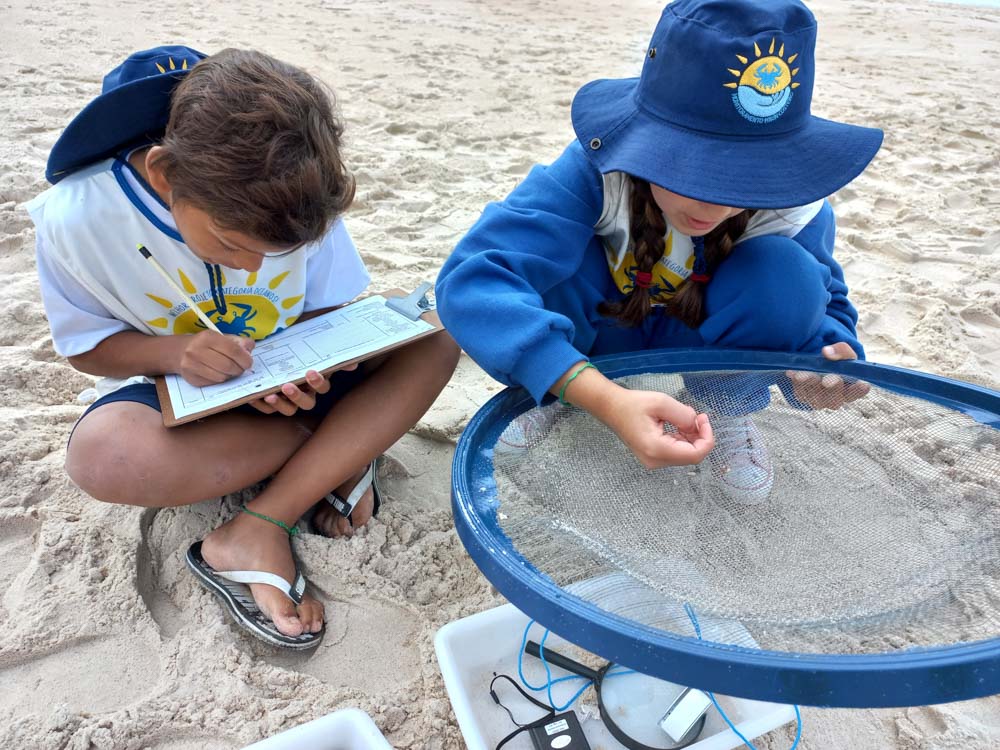
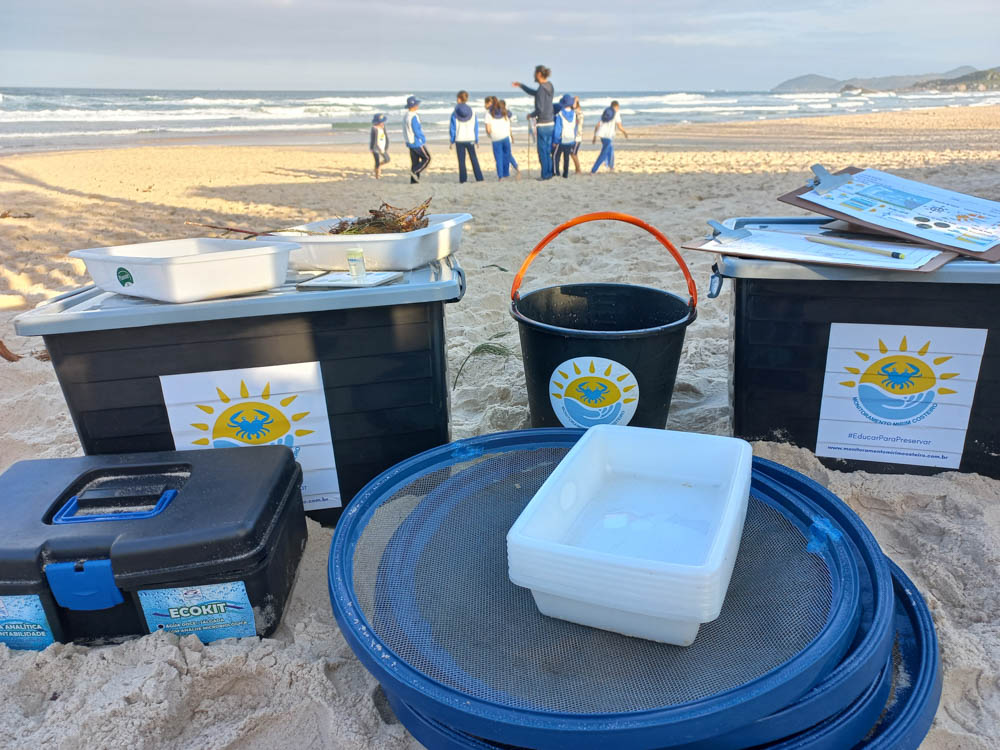
Whether on land or at sea, in the country or abroad, citizen science has potential and is strengthened when incorporated into education from an early age. By involving children in the monitoring of the coast where they live, a group of researchers started, in 2012, the program Junior Coastal Monitoring Institute (IMMC), in Garopaba/SC. The oceanographer and founder of the institute, Caroline Schio, explains that the initiative has a pioneering scientific method so that children from 9 to 11 years of age can research and monitor the beaches of the ocean coast. “Through the Citizen Science approach, we aim at providing the kids with scientific learning experiences so they can built knowledge, in a practical and collaborative way, about the coastal-marine environment where they live, and feel like researchers, monitors and ‘young guardians of the ocean’ ”.
Each school monitors the beach in its neighborhood, conducting two field trips during the school year. Besides gathering environmental data during the monitoring of the beaches, students also analyze the results, make graphics, tables, texts and interdisciplinary work with teachers through the school year. These data are displayed in educational signs on the monitored beaches – a way to communicate and raise awareness among the community and tourists about the preservation of the coastal zone. Schio emphasizes that the information is also stored in a database that will become an open access, interactive, online platform in the second half of this year.

“Regardless of whether the projects are too complex or too simple, the most important things are that they are attractive – with the potential to engage as many citizens as possible – and that they involve local problems to be investigated in order to find collaborative solutions and improvements for the communities.”
Caroline Schio
Thus, by educating children, Citizen Science becomes more comprehensive and develops a basic educational training. According to the oceanographer, the potential for higher impact in this type of research is given by the citizens themselves – who become participants in the investigation, as well as spreaders of knowledge and change in their communities.
This interaction and this engagement with residents around research locations ended up being essential to the research on the vinaceous-breasted parrot – points out the researcher and doctor, Viviane Zulian. “We’ve created a communication channel with the residents via WhatsApp, in which they can send photos and videos of the parrots. It’s not possible to think about preserving biodiversity without integrating and raising awareness among residents about the importance of species preservation,” she says. Furthermore, the use of the data gathered by “citizen scientists” is a way to value and include this knowledge in scientific research – the training being one of the steps to consolidate Citizen Science with quality, state the researchers.
“I would like to highlight the fact that the role of Citizen Science goes far beyond contributing to the expansion of the database of knowledge about certain fields of science,” stresses the UFBA’s researcher. To her, there are several studies that show its importance in the very construction of scientific citizenship, scientific literacy and the development of critical thinking, training people to be resistant to pseudosciences – people who are capable of understanding the complexity of real-world problems –, formulating public policies, allowing decision-making and, moreover, favoring citizen participation in the management of natural resources and environmental protection.
Translated into English by Luísa de Figueiredo Dias, undergraduate student enrolled in the course “Supervised Translation Training II (English)” of the Undergraduate Program in Language and Literature, under the supervision and translation revision of Professor Elizamari R. Becker (P.h.D.) – IL/UFRGS.