
Innovation | Higher education institutions ensure qualified training for entrepreneurs and promote interaction between business and research
*By: Ana Paula Tavora
*First published January 30, 2025
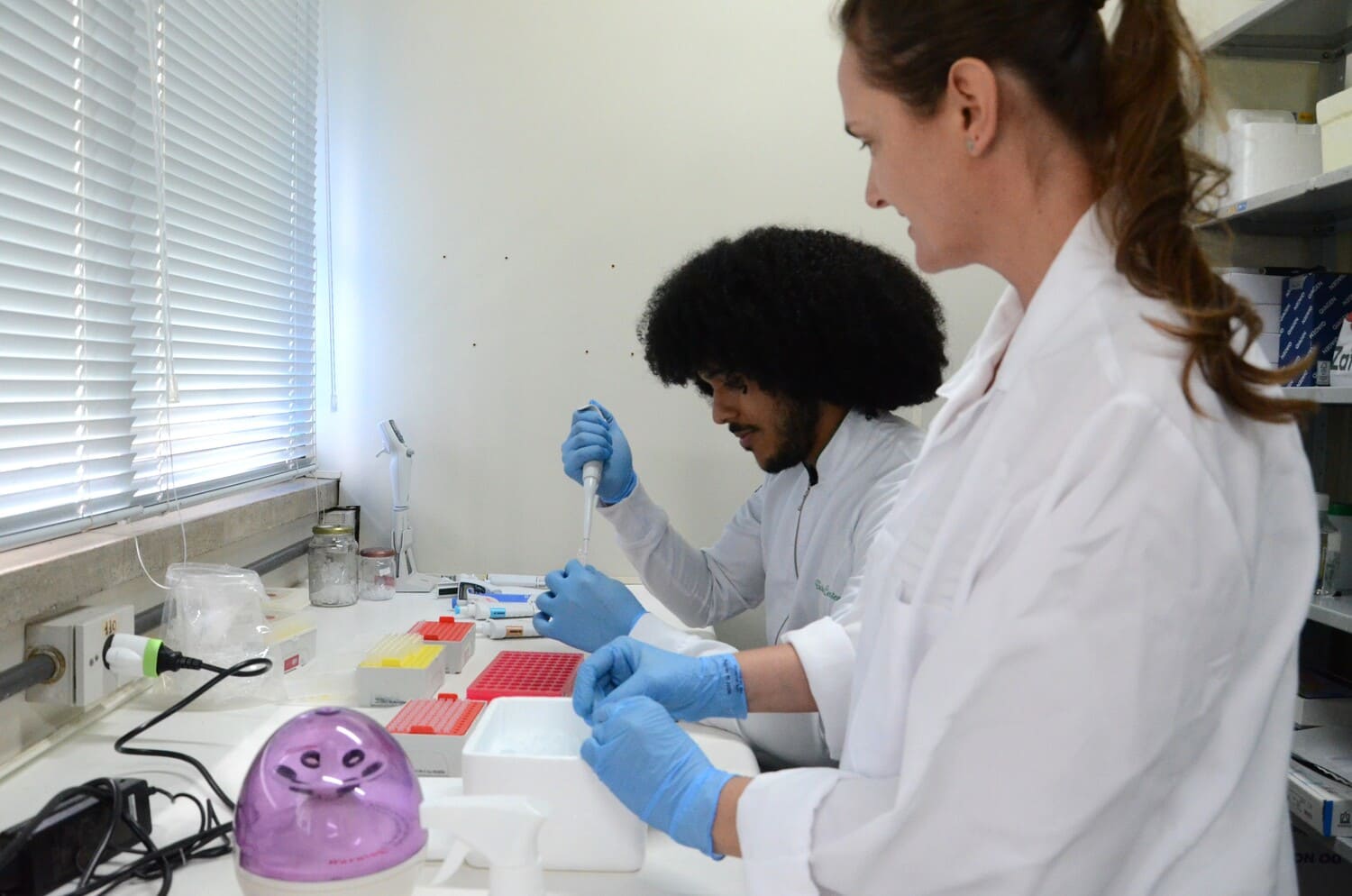
*Photo: Victor Cortez, student with an undergraduate research fellow, and Patricia Schonhofen, postdoctoral researcher in Industrial Development, work on OsteraTest, a tool that identifies eggs with higher chances of developing into viable embryos. This initiative was designed by Ostera, a startup affiliated with the Business Incubator at UFRGS’ Biotechnology Center. (Photo: Pietro Scopel/JU)
Patricia Philips and Drika Lima were bothered by the lack of inclusivity and support for the queer community in bars, restaurants, clothing stores, and even in professional environments such as psychological clinics and law firms. In this context, they became professional partners and created a platform that promotes safe spaces, services, and products for all audiences: Abalô Conexões Plurais (Abalô Plural Connections, in a free translation), a marketplace focused on LGBTQIAP+ people.
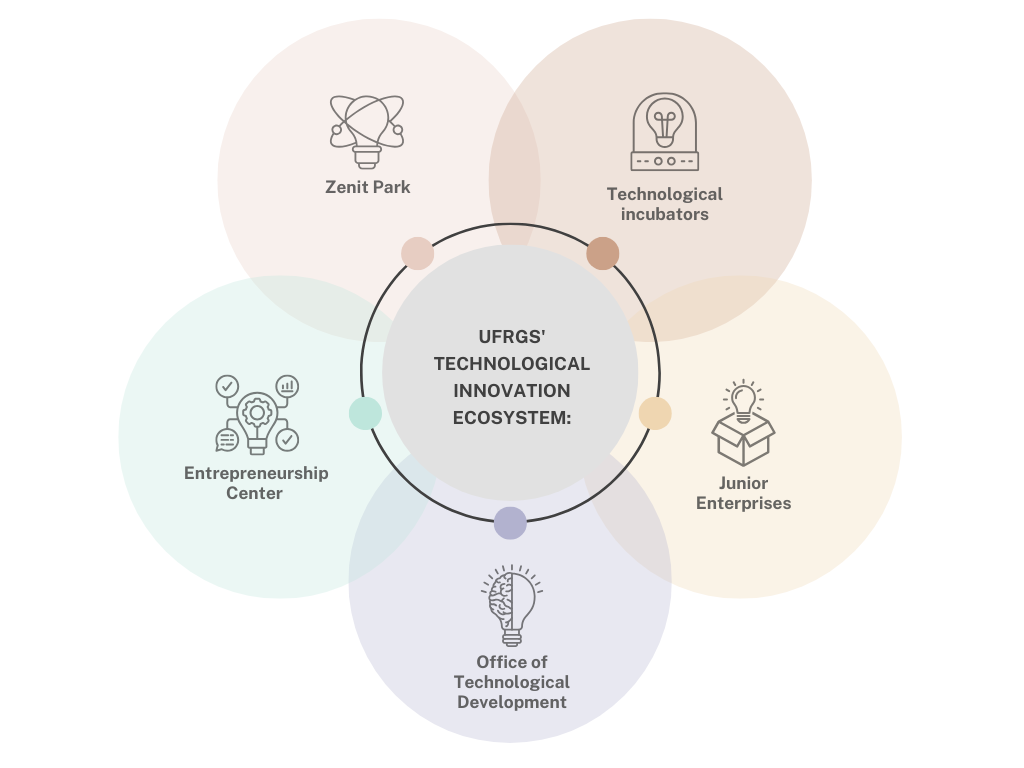
In 2022, one year after being registered in the National Register of Legal Entities (CNPJ), Abalô was selected by CEI Impacto, a program linked to the Entrepreneurship Center of UFRGS Institute of Computer Sciences. This program is exclusive for initiatives that are concerned both with promoting social improvements and achieving financial results. CEI is one of the five technology incubators at UFRGS and it supports the development of innovative ventures with the technical assistance of academic departments.
Abalô is currently in the pre-incubation stage, which is an initial phase in the process of starting a startup. Abalô’s creators take part in mentorship sessions, connect with other companies, practice their pitch (a concise business presentation), and make use of rooms equipped with computers, desks, and Wi-Fi. Patricia and Drika, who frequently seek to improve their entrepreneurial skills, realized that the incubators represented an opportunity to boost their business. “That’s why we’re part of this partnership with UFRGS: through market research and studies involving entrepreneurs, the students help us improve our work. INF (Institute of Computer Sciences) is also helping us improve our website” – points out Patricia.
Besides the Institute of Computer Sciences’ Incubator, there are other four incubators at UFRGS:
I. IE-CBiot, which is associated with the Biotechnology Center;
II. Héstia, which is linked to the School of Engineering;
III. ITACA, which is connected to the Institute of Food Science and Technology;
IV. IMZ, which is jointly associated with the Schools of Pharmacy and Economics and the Interdisciplinary Center for Society, Environment, and Development (CISADE).
Together, these incubators have already helped 52 companies grow and currently host 31 startups in development.
Usually located within the technology hubs of higher education institutions, these organizations primarily serve educational rather than commercial purposes. In fact, 61% of Brazilian incubators are supported by universities, according to a study conducted between 2018 and 2019 by the National Association of Entities Promoting Innovative Enterprises (Anprotec), in partnership with the Ministry of Science, Technology and Innovation and the National Council for Scientific and Technological Development (CNPq).
At UFRGS, Zenit Park is the department that oversees pre-incubation and incubation policies, assigns activities among the incubators, selects companies through a public call for applications, and supervises the final status of the startups. In fact, the Park is currently accepting applications for new ventures through the Unified Incubation Call, open until February 1st.
According to Zenit Park’s director, Marcelo Favaro, the incubators main goal is not to test the product’s success rate, but to guide entrepreneurs by providing legal, accounting, marketing, and people management knowledge.
If, by the end of the journey, the company does not get off the drawing board, we will have contributed to society by shaping an individual whose education goes well beyond technical training — a professional who has developed skills in important areas.
Marcelo Favaro
A new career choice for researchers
Innovative ideas can also be developed throughout a student’s journey in university. For example, biologist Lucia von Mengden, during her master’s and doctoral studies at UFRGS, developed a method to increase the success rate of in vitro fertilization by reducing the number of cycles needed to achieve pregnancy. This started as a groundbreaking research and also became an award-winning startup—Ostera—derived from the Programa Centelha (Centelha Program), driven by the Entrepreneurship Marathon and AcelerEA, and incubated at IE-CBiot. This company developed a software that identifies eggs with higher chances of developing into high-quality embryos.
Ostera is now undergoing internal incubation, a model in which the venture depends on the incubator’s physical facilities. This means that Ostera has to pay rent for the space it occupies and pay UFRGS 2.5% of its annual sales, unlike Abalô, which is still at the early stages of its learning journey.
For von Mengden, although now there are expenses, it would not be possible to start the company without the entrepreneurial support from the Biotechnology Center. “The processes are very expensive, and we do a lot of research; without research, we can’t develop our product. I wouldn’t have been able to open a lab on my own from the start, and the incubator was essential for that, so I think it’s fair that we give something in return to the University,” says Lucia von Mengden, who manages the company alongside Professor Fábio Klamt from the Department of Biochemistry and postdoctoral researcher Marco Antônio de Bastiani.
One of the main contributions of the incubators, according to Favaro, is providing scientists with instruction so they can start their own business and envision career paths beyond traditional roles in the job market. Von Mengden, for instance, wanted to conduct research but was not a professor, so by creating Ostera she combined the best of both worlds and competed for prominence alongside other major projects. In 2024, the company won the startup competition at the South Summit—an international meeting of entrepreneurs and investors annually held in Porto Alegre—in the “Most Scalable” category, recognizing business models capable of rapid growth with minimal investment.


Success Rates and Sustained Partnerships
Evidently, UFRGS is not the only institution that offers incubators to support aspiring entrepreneurs in Rio Grande do Sul. According to data collected by the State Office of Innovation, Science and Technology, there are 40 other technological incubators in Rio Grande do Sul. Moreover, one third of them are located in the Metropolitan Region, such as the incubator at Feevale Techpark, affiliated with Feevale University, which has developed a method for assessing the quality of the education provided to the companies it supports.
“We developed a pre-incubation indicator, which includes five areas: entrepreneurship, management, capital, market, and technology. We collect data at the beginning and end of the process to measure the level of knowledge acquired by the pre-incubated entrepreneurs,” explains Moema Pereira Nunes, PhD in Administration from Unisinos and advisor to the pre-incubated projects at Feevale. According to Moema, conducting surveys ensures that the expertise and infrastructural support provided by the incubators are continuously improved.
In this context, there is another practice that improves ventures, which is post-incubation, offered by the Federal University of Pelotas (UFPel). Conectar, UFPel’s incubator, keeps track of the progress of graduated business through their annual revenues and encourages partnerships between established startups and those still in formation. According to Adalice Andrade Kosby, Conectar’s manager, companies that have already gone through all stages of incubation provide instruction to those in incubation and pre-incubation phases, aiming at maintaining a connection with the university and facilitating exchanges between experienced entrepreneurs and newcomers.
From social to scientific initiatives, whether emerging within or outside academia, entrepreneurship is no easy feat. Nevertheless, the growth prospects pursued by both Abalô and Ostera have significant potential to come true, as the startups are integrated into a specialized and privileged network of connections. According to Moema Pereira Nunes, incubators create a rich environment that encompasses all areas of knowledge and encourages interaction among different participants. “The pre-incubators and incubators help entrepreneurs grow – unlike a company outside the innovation ecosystem – and prepares them to better handle changes.
Translated into English by Laura Lameira Ekman, undergraduate student enrolled in the course “Supervised Translation Training I (English)” of the Undergratuate Program in Language and Literature, under the supervision of Professor Rozane Rodrigues Rebechi (PhD) – IL/UFRGS
:: Read in portuguese
Incubadoras tecnológicas impulsionam negócios e convertem ideias inovadoras em startups competitivas