
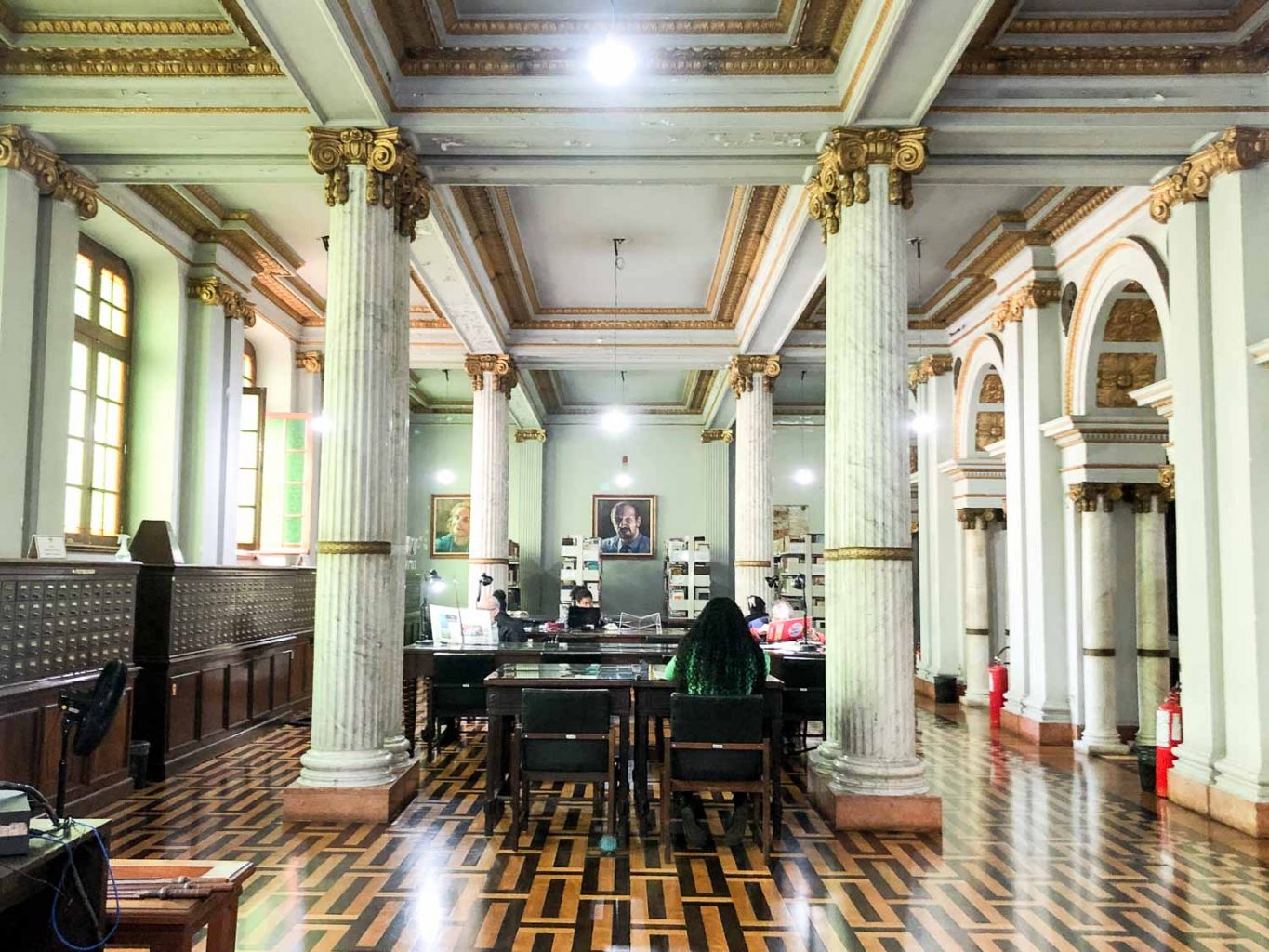
Memorial | At UFRGS, 24 buildings are considered historic and have legal protection. Scanning can assist in heritage conservation, but it is a time-consuming process and doesn’t progress (or progress slowly) due to lack of resources
*By Stéfani Fontanive
*First published December 1st 2022
*Photo by: Flávio Dutra/ Arquive JU October 4th. 2022
One can follow the development of Rio Grande do Sul by roaming the central region of Porto Alegre, where you can observe skyscrapers built next to buildings that are over 100 years old and. In the capital of RS, there are 25 listed items by IPHAE (Institute of Historical and Artistic Heritage of the State), while UFRGS alone has 24 legally protected properties. These buildings are classified as historical or cultural heritage.
In the state, there are 156 listed properties by IPHAE, including buildings, squares, bridges, railways, and waterway stations. The cultural preservation of properties is an administrative act made by the public authority that aims to protect the original characteristics of properties and monuments of historical, cultural, environmental, and/or architectural value, as well as of affective significance for the population.
One of the great challenges in relation to historical heritage is the preservation, and UFRGS holds a project which intends to be of assistance in this aspect. It is the LDSM (Design and Material Selection Laboratory), which carries out the scanning of these properties, among several other activities. Fábio Silva, the engineer responsible for the laboratory, explains that this type of scanning can be used in many ways for historical preservation. Both the organization of the documentation related to the property –that is necessary for issuing the preservation administrative act, for the analysis of the building’s materials and for the maintenance of the site history for future generations – and the planning of future restoration works are among the prospective applications of scanning.
Scanning can even be used to rebuild the properties, says Antônio Sarasá, from Sarasá Studio, the company responsible for the restoration of Château D’Eau, monument which lies in the city of Cachoeira do Sul. Antônio mentions the example of Italy, where the process is widespread due to constant earthquakes and the consequent loss of buildings. In the city of Esteio/RS, historical buildings like the Claretiano Seminary were damaged by a fire and had to be reconstructed. Scanning the monument would have significantly facilitated the endeavor. Fábio reiterates that a historical heritage cannot be reconstructed without a solid documented base which may tell the story of the place.
Scanning requires resources and time
Two UFRGS’ buildings have already gone through the scanning process: the Institute of Chemistry’s façade, vases in detail, and its statues, as well as details of the old building of the Faculty of Medicine, on the corner of Sarmento Leite and Engenheiro Luiz Englert streets.
Before UFRGS can see the other 22 historical buildings catalogued, two requirements need to be met: resources and time. Fábio explains that there is more than one way to scan a monument and that the laboratory has scanners with three different technologies. In all of them, it is necessary to capture images of the building, what takes, on average, one day, but this also requires scaffolds and space. To scan O Laçador, the sculpture made by Antônio Caringi, the assistance of the municipality authorities, which provided a truck to raise the equipment up to the height of the statue, was necessary. For the scanning of the Medicine building’s details, the researchers visited the place at night, “to avoid sunlight from interfering with the capture of the monument’s colors”, comments Fábio.
Despite the speedy one-day image making, information processing takes more time and requires more resources. After the material has already been collected, it is necessary to “treat the data”, by building a point cloud, a three-dimensional coordinating system that will organize and examine them. Fábio explains that this work can take months and requires high-performance computers.
Another application is the digital exposition of the properties.
“It is possible to make a virtual tour, showing the facade, thus more people will know the place.”
Fábio Silva
LDSM was also responsible for cataloging and making available, for example, the acquis of UFRGS’ Natural Science Museum, located in the city of Imbé, and a virtual tour in the main room of the Museum. “In that place there is the skeleton of the humpback whale, which was scanned,” Fabio says. The virtual tour assists in the memory preservation of the museum and, moreover, in its accessibility, for a wider range of people to visit the place.

Administrative Preservation Act
“The regulated restoration and preservation of historical properties must follow the law,” explains Luísa Gertrudis Durán Rocca, who takes part of the Culture and Heritage research group affiliated to the Graduate Program in Museology at UFRGS. The recognition of properties of traditional cultural significance requires that an administrator – public or private – gathers information about the property and submits it to the responsible authority. “If a property is important to the city, it will be registered at the municipal level. If it is important to Rio Grande do Sul, then the property will be registered at the state level. And, if it becomes national, a federal level will be reached,” explains Renata Manara Tonioli, head of the historical heritage sector at UFRGS, administrative area of the University in charge of the restoration and maintenance of historical buildings. In Porto Alegre, the division in charge of historical heritage is the Municipal Secretary of Culture. In Rio Grande do Sul, it is managed by IPHAE and in rest of Brazil, by IPHAN (Institute of National Historical and Artistic Heritage).
The University is a good example of heritage protected in different levels of competence. At the national level, there is the Astronomical Observatory. Among those protected at the state level, there is the Engineering School, which, according to Renata, “belongs to the history about the development of the State of Rio Grande do Sul”. However, the University buildings are not protected by an administrative act, but by the State Law No 11.525, passed in 2000, which “designates the historic buildings belonging to the Federal University of Rio Grande do Sul as part of the State’s cultural heritage.”
In Brazil, the protection of historic buildings began in 1937, during the Getúlio Vargas government, through the Decree-Law No.25, passed on November 30th of that year. In Rio Grande do Sul, historic heritage preservation of properties started in 1980, when IPHAE was founded. Luísa explains that defining heritage is always a complex process, since, at different times, different assets are considered heritage.
“The heritage definition is related to values, and each period, each generation, decides what heritage is.”
Luísa Gertrudis Durán Rocca
The restorer Anice Jaroczinski works on the restoration of the wall paintings from Public Library of Porto Alegre, which has been recently reopened.

The period with the highest number of protected properties was in the 1980s, when the foundation of IPHAE took place. In 1986, 26 properties had their cultural heritage status recognized at the state level, while in the 2000s few buildings were protected – between the years 2002 and 2005, no building was registered. But in the 2010s, the protection of properties was resumed and, in 2013, 23 buildings became protected.
In the state, old residential buildings constitute the highest number of protected properties, around 30% of properties were registered for the most part in the 1980s – places where politicians – like Borges de Medeiros, Getúlio Vargas, and Júlio de Castilhos – or writers – like Simões Lopes Neto – lived; and even Italian, German, and Portuguese immigrants’ first houses in the state, like the Casa dos Veronese in Flores da Cunha, or Sobrado dos Azulejos, located in the city of Rio Grande.

Antônio Sarasá points out that different properties must be preserved, even if their architecture may seem simpler. This is the case of the Cultural Club Fica Ahi Pra Ir Dizendo, a carnival club from the city of Pelotas, and also the case of the Cultural Club 24 de Agosto from the city of Jaguarão, associations focused on the black population of the state, both properties were registered preserved cultural heritage in 2012.
Luísa, Antônio, and Renata agree that, to take care of a property, it is necessary to know it. But Luísa points out that social recognition is even more important than governmental recognition.
“The preservation of the cultural heritage of a property is important, but it is not the only point. If the society doesn’t give recognition to it, it is useless.”
Luísa Gertrudis Durán Rocca
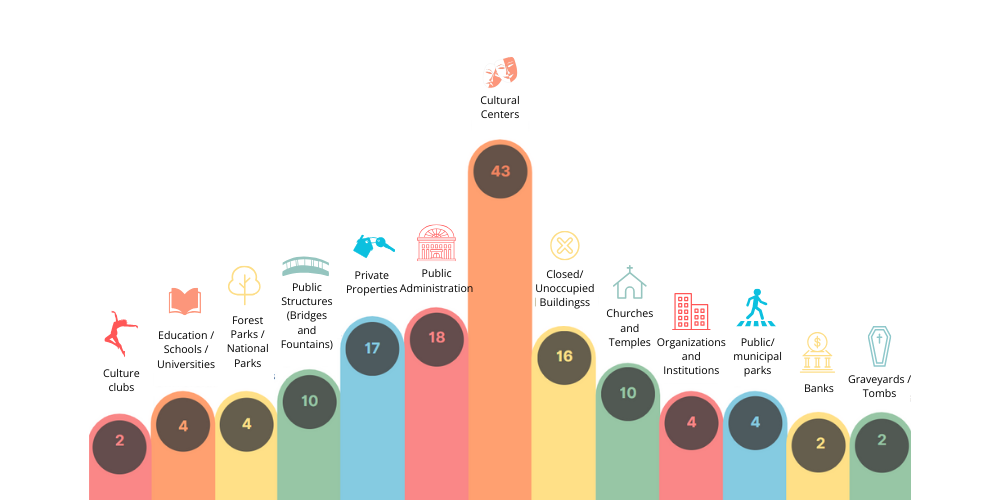
Among 156 buildings protected by IPHAE, 35 kept their original purpose. In Porto Alegre, among the 25 preserved items – including furniture and adornments from the place –, 14 kept the same application or use. These are the cases of the State Public Library, of the São Pedro Theater and of the Capitólio Cinematheque. Most buildings, however, got repurposed from their original construction function: 43 turned into cultural centers, such as museums, libraries, and culture houses. Divisions of the public administration occupy 18 buildings, including 10 municipal offices, three city halls and the headquarters of the state government, the Piratini Palace. The opening of these places to the population has complied with what the interviewees so often mentioned: proper care of historic properties is only achieved when the community knows and uses them.
Routine care and memorial preservation
Renata explains that taking care of a cultural and public property is not simple. “Any sort of intervention in a historical building at UFRGS must be approved by the historical heritage sector.” From paintings to the stipulated use for a room, it is necessary to carry out a study, to guarantee the preservation of property originality. Renata also says that the University is a cultural property belonging to the whole society, so it needs to be opened to the public. This is the case of UFRGS’s Cultural Center whose restoration work was concluded in 2018.
Routine, care, hiring of services and labor are matters that affect the conservation of a building, says Maria Clara Bassin, head architect for the Piratini Palace. She reports that, to take care of a building, it is necessary a multidisciplinary team. Luísa agrees with Bassin and adds having historians, architects, engineers and restorers working together is priceless.
Maria Clara also explains that there is a prime difference between conservation and restoration.
“Conservation is meant to avoid restoration, because every restoration is a loss.”
Maria Clara Bassin
Antônio adds, stating that “restoration should always be an exceptionality, but in Brazil it is considered a regular occurrence”. The restorer says that the most important aspects are prevention and conservation. Luísa points out that those who take care of the heritage “consequently help putting out fires”.
In addition to the building maintenance and care, cultural properties also have another very important factor: memory maintenance. “Piratini Palace keeps the history of Rio Grande do Sul,” says Maria Clara, just as UFRGS keeps with it the history of education development both in Rio Grande do Sul and in Brazil.
But the UFRGS’ buildings also indicate the memories of the people who studied in or worked for the University. The restorations of the University buildings are funded by sponsorship regulated by the Culture Incentive Law. Most donations come from natural persons, out of whom many are alumni. “For example, take the case of the São Pedro chapel, at the Experimental Agronomic Station: all donations were given by natural persons, and many of them had their own wedding ceremonies held at the chapel,” says Luísa.
Both collective and individual memories aid cultural heritage preservation. A cultural asset or property does not become cultural heritage just because of its architecture, but because of its symbology, because of what it means to the community. Politicians’ former houses recall the history of those public figures. Buildings that have immigration characteristics tell the miscegenation story of Rio Grande do Sul. Buildings tell stories and hold memories of past times and, more importantly, tell stories about the people who lived at those times. “Historical heritage is a support for collective memory,” sums up Luísa.

Translated into English by Daniel Senna Irgang, undergraduate student enrolled in the course “Supervised Translation Training I (English)” of the Undergraduate Program in Language and Literature, under the supervision and translation revision of Professor Elizamari R. Becker (P.h.D.) – IL/UFRGS.
:: Read in Portuguese
A digitalização como meio de preservação do patrimônio cultural