
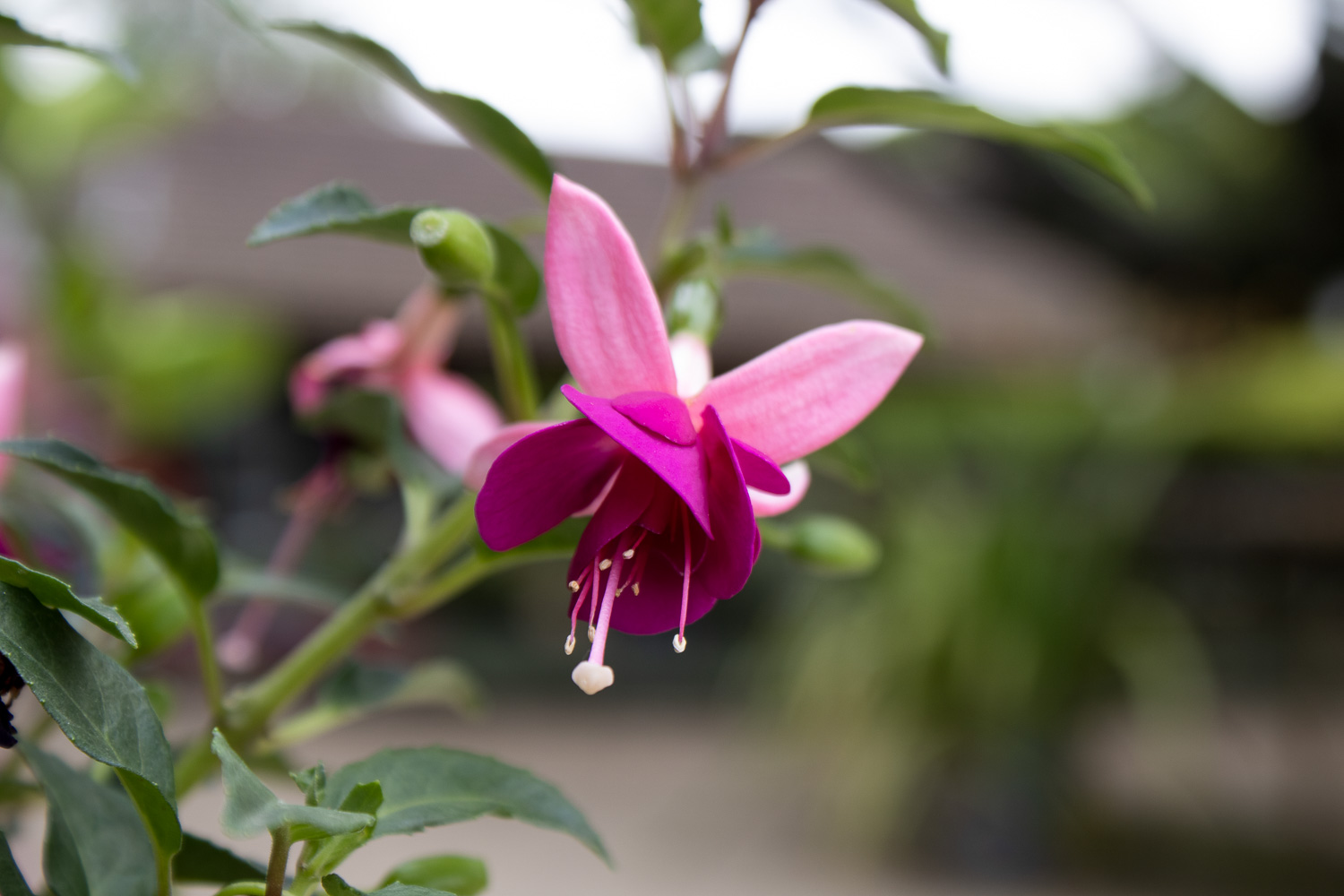
Experts highlight that a cultural change is necessary so that the native flora of Brazilian southern state Rio Grande do Sul has more prominence in the market and is more present in florist shops and residences
*By Samuel Ruiz Anklam
*First published 24 November 2022
*Photo: Ana Terra Firmino/Ju – Fuchsia regia, consideredby a state
decree of 1998, the symbol flower of Rio Grande do Sul (RS)
The popular saying “Beauty is in the eye of the beholder” can help explain what an ornamental plant is. If grown indoors, any plant has the potential to be ornamental, provided they have some outstanding feature that catches the customer’s attention at the flower shop or fair. The subjectivity of beauty is what drives diversity. While some prefer the species with colorful flowers, such as the Rosa chineseis, others choose the “green plants”, like the Dracaena trifasciata.
There are several factors that shape the preference of customers and guide their purchases. Often it is only the appearance, but there are those who arrive at the flower shop with a specific species in mind, as they saw it in the house of a friend and liked it, or they have a childhood memory linked to a certain plant. There are also collectors who fall in love with a certain group, such as orchids, and are always looking for variations to expand their collection.
Due to these factors, some species have already established themselves in the market and can be found in almost every home of people who embrace cultivation as a hobby. Trends are also an important factor – yes, there are also plants that are “fashionable” – however, there are hardly any native plants from Rio Grande do Sul in flower shops. Despite the great Brazilian biodiversity, many flowers and plants that we see in our daily lives come from other places, such as Paeonia, which, although typical of cold zones, is widely sold in the country.
Consumer interests and native plants
Each plant has its individuality and must be cared for in a specific way, but some general rules facilitate care and are disseminated even by those who are not experts on the subject. When cultivation is done indoors, shade plants are more suitable, as they require only indirect light and do not need sun exposure, can stay in bedrooms, kitchens and living rooms that have windows and a bit of luminosity. Among the most common, we can mention the Cyclamen persicum, and Polypodium persicifolium, which can be found in most florists.
Whether the species is or isn’t native is not a common concern of most florist customers, who usually pay more attention to issues related to the cultivation of the plant. According to Taiane Rodrigues, a biologist, and owner of the Ave do Paraíso flower shop for 18 years, “People want to know how they will take care of the plant so that it doesn’t die.” The biologist believes that this is due to the lack of environmental education – especially in school, which, according to her, has little focus on botany, despite the massive presence of nature in Brazil.
Bringing this topic to the perspective of the southern state of the country, Rio Grande do Sul, we can observe that few plants marketed for indoor cultivation are native to our state. This is mainly due to the nature of our biomes. The Pampa, exclusive biome of the territory of Rio Grande do Sul when compared to the national scope, occupies 63% of the state and is characterized by herbaceous plants, shrubs and small trees, which need more sun and are not conducive to cultivation indoors.
One of the native possibilities for indoor cultivation is Fucshia regia – which is even the symbol flower of Rio Grande do Sul. The native species of the Atlantic forest receives its name, brinco-de-princesa (princess earring, in free translation), due to its resemblance to earrings and is characterized by beauty and adaptability, resisting even the cold and frost of the state’s winter. Despite flowering throughout the year, the earring is usually fuller in spring and summer, and is commonly visited by hummingbirds in its flowering period. The plant can be grown indoors provided it sits near a window and stands in the sun for a few hours a day.


Cultural issues and regional plants
It is also important to understand the process necessary for a plant to leave its habitat in the wild and be commercially available. Among these factors, it is necessary to understand how the plant behaves in cultivation, if it produces seeds to propagate itself, and how much luminosity it should receive. In addition, it is illegal to collect plants from nature for commercial exploitation, so there are legal procedures that precede the insertion of a species on the market.
“You should always take into account where the plant came from and what it is suitable for,” explains Gilmar Schafer, professor at the Faculty of Agricultural and Life Sciences at UFRGS, and researcher of Floriculture. According to Schafer, it is also important that plants have an economic value, and thus attract the market, to start the production process.
This cultural change is a slow process, and it is unlikely to start with the consumer. “Landscaping professionals have a great responsibility in this regard,” emphasizes Sérgio Tomasini, a professor at the Faculty of Agricultural and Life Sciences at UFRGS. If landscapers expand the use of native plants of Rio Grande do Sul in their projects, which results in purchases in large quantities of certain species, this draws the attention of the market and helps in the cultural change of the population.
“If there is a population interested in native plants, and a demand, the market will have to adapt and increase its supply,” says Schafer. An example is the Orla do Guaíba Urban Park, a project that has the reintroduction of native species as one of its grounding goals.
The use of local species is important not only for the enhancement of regional flora, but also for the preservation of species. The Pampa biome has been suffering from increased deforestation and the growth of soybean crops, which is detrimental to native vegetation.
“If you want to preserve a species, give it economic value.”
Gilmar Schafer
Cultural transformation is a constant movement, and it is vital that knowledge about regional plants is disseminated among the population so that the market is compelled to adhere to local products. Roberto Burle Marx once said, “A garden is a nature organized by man and for man.”
Translated into English by Alex Porto Teixeira, undergraduate student enrolled in the course “Supervised Translation Training I (English)” of the Undergraduate Program in Language and Literature, under the supervision and translation revision of Professor Elizamari R. Becker (P.h.D.) – IL/UFRGS.
:: Read in portuguese
Em que prateleira estão as plantas nativas?