Education | Sites and folders hosted in the cloud give access to solved assignments, class summaries, and PDFs of books, a practice that violates copyright and annoys teachers
*By Giordano Benites Tronco
*First published July 20, 2023
*Picture: Marcelo Pires/JU
For José Ribeiro Gregório, professor of Inorganic Chemistry at UFRGS, leaking exam papers is nothing new. He has been familiar with the famous “Xerox folders” for years, left by some “good soul” senior in photocopying establishments with class summaries and solved exams.
The new feature, for José Ribeiro, is the form and scale taken by the unauthorized sharing of these materials in recent years.
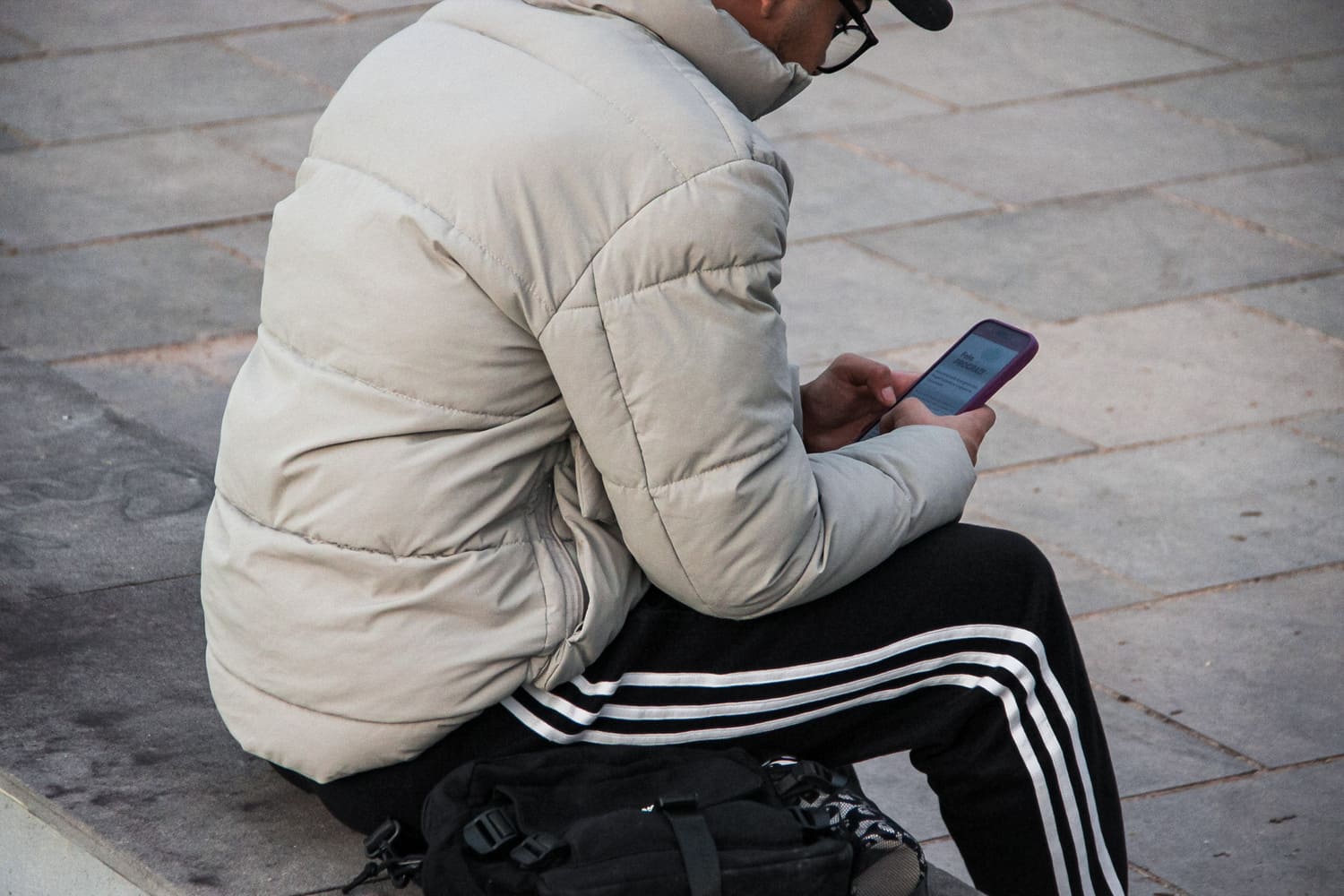
Today, colleagues exchange exam answers in closed groups on apps. Academic Departments keep virtual folders with photos of corrected exams, neatly organized by semester, subject, and teacher’s name. And while before it was only small photocopying establishments that profited from this transaction, today there is an ecosystem made up of internet platforms (usually paid) that host materials without authorization, students willing to pay money to access them and students willing to profit from the sale of exams and summaries.
It is becoming more and more common and is generating debate on various fronts, from the issue of copyright for these materials to the way teachers deal with the scenario, including the assessment of learning: does a test count as an assessment tool, for example, if the student has access to the templates in advance?
Students who help students
It’s not difficult to find material shared without authorization on the internet. It’s not hidden. It can be found by searching on Google, on the Instagram of an academic directory… or even from a report in the University Newspaper (UN).
In March, the UN published a profile of Bruno Kalil Medeiros, a graduate of the Economics course at UFRGS and the creator of a website whose main function is to serve as a repository for materials shared by students.
After the story was published, we received emails from two UFRGS professors – one of them, Professor José Gregório, mentioned at the beginning of this article – who said they were “shocked” to find materials for their subjects on Bruno’s platform.
José Gregório says he doesn’t mind making materials available to help students study, but he is adamant: you can’t do it with exams.
“There is no problem in making class materials available, but that’s not what they – the students – are interested in. They want to access the exam so they don’t need to study for it.”
José Ribeiro Gregório
Bruno, the creator of the digital platform, found out about the teachers’ reaction when he was interviewed for this report. He said he didn’t want to affront any teachers and was willing to remove any unauthorized material upon request of the author. But he stressed that his site is not the only one where this sharing takes place.
And it really isn’t. According to UN’s investigation, at least five academic departments at UFRGS keep online folders (drives) with some kind of irregular material (copies of exam papers, class summaries, PDFs of copyrighted books or slideshows). All of them can be easily found on their Instagram page. On some of these drives, summaries, exams and assignments are organized by semester, subject, teacher, and type of material.
The director of one of these academic departments, who chose not to be revealed, knows that this practice is illegal, but compares their work to that of a Robin Hood: not all students can afford to buy the books, and the UFRGS library doesn’t have enough copies.
The interviewee thinks that the wide access to archives contributes to learning. Lesson summaries make life easier for those who find it difficult to pay attention to the teacher and take notes at the same time. The publication of old tests forces the teacher not to repeat the questions in the assessments for the following semesters.
But do the teachers know that these copies exist? “They know, but they don’t make a point of knowing,” he explains. “I tell the teachers that there’s a drive, but they don’t ask what’s on it.”
A profitable business
While some share files inspired by Robin Hood, others have a different motivation: money. There are business models based on sharing academic intellectual property, including funding from large, well-known companies.
This is the case with Passei Direto, a site belonging to Uol Edtech. It is very similar to the platform of the previously mentioned Bruno Medeiros’, but with hundreds of users, thousands of shared files and a system of communities of interest similar to Facebook groups. Users register on the site, pay a fee – starting at R$19.90 (around $4) per month at the time this article was written – and have access to tests, slides and summaries of the most varied subjects, from different universities, schools and foundations organizing public exams.
However, it is not these institutions that supply the site with content, but the users themselves, who can even become “verified producers” and earn money from their submissions. Copyrighted material is the exception.
Passei Direto is not the only site of its kind. Other networks, most of them paid, operate in the same way. Bruno Medeiros’ own site (Fokvs) – which until now had been available for free – has spread posters around UFRGS inviting students to “monetize” old exams and assignments through the site. Bruno says it’s a strategy to increase the site’s user base and that he’s not earning anything from the materials – he claims that, on the contrary, he’s paying for the user rewards out of his own pocket.
Copyright protection
All these material-sharing platforms are careful to point out in their terms of use that they are only intermediaries in the exchange of files between users. In other words: if there is an illegal act being committed, it is the responsibility of the person who sent it.
This excuse doesn’t “stick” for UFRGS Law School professor Kelly Lissandra Bruch. In her interpretation of Brazilian copyright law (Federal Law Nr. 9,610/98) and the Brazilian Civil Rights Framework for the Internet (Federal Law Nr. 12,965/2014), those who host content are responsible for its legality. If a user uploads material containing pedophilia, for example, the owner of the platform can be held legally responsible for this. After all, they are somehow allowing the material to be transmitted. This goes for any other type of illegal content, including copyright infringements.
The same responsibility applies to academic departments. The leader of the institution can be held civilly and criminally liable, even if they were not the user who posted the material on the internet – as they are legally responsible for the virtual folder.
LEGAL RESPONSABILITY
In the Civil Sphere
Lawsuit for moral damages (to the figure of the author) and material damages (equivalent to what the person missed out on with the free distribution).
Penalty: compensation for the damage. In the case of illegally copied books, it is agreed to charge an amount equivalent to 3,000 copies.
In the Criminal Sphere
Crime of copyright infringement (art. 184 of the Penal Code).
Penalty: if there is no profit in the act, imprisonment from 1 to 3 years or a fine. As it is a minor crime, it is possible to obtain a conditional suspension of the sentence and convert it into community service. If the infringement was for profit, the penalty can be up to 4 years in prison.
Kelly is clear that no student or website can publish a teacher’s exams without their consent. Article 46 (IV) of the Copyright Act explicitly prohibits the full or partial publication of “the collection of lessons in educational establishments” without the prior authorization of the person who gave them. This applies to exams, exercises, report templates, slides and even summaries of a teacher’s lesson, because even if the text of the summary is authored by the student, the intellectual organization of the content is not.
“The teacher’s intellectual effort to structure a lesson is not obvious to the student. They take it for granted. I say that because I used to be a student. But it’s like copying an article, a book”
Kelly Lissandra Bruch
Copyright limits
There are cases in which using someone else’s work is not a crime. It is permissible to use excerpts from someone else’s intellectual work in the form of a quotation, i.e., when its reproduction is not the main purpose and provided the author is quoted. This reproduction must not harm the commercial exploitation of the original work or cause unjustified damage to the author’s legitimate interest. This also applies to videos, visual arts and photographs.
This exception is comparable to the doctrine of fair use in other countries. Fair use is the legal understanding that copyrighted material can be reproduced when it does not harm the author and does not constitute plagiarism.
Brazil does not have a fair use policy, but article 46 of Law Nr. 9,610/98 lists the limits to copyright protection. According to Kelly, recent decisions have already understood that these limits are exemplary and, therefore, other situations of exception could be included.
The limits of the law’s protection – which prevents the reproduction of lecture notes but allows quotations from works – creates apparently contradictory situations. The reproduction of an exam paper is forbidden; that of the answer sheet, when made by the student, is not.
Recording a video showing how to solve a test question is also perfectly legal, as it is an original intellectual work and the wording of the question, although essential for the existence of the video, represents a small part of it. Even so, the source or author of the question must be cited.
CANs and CAN’Ts
You can
- Share answers (lists of correct alternatives to questions)
- Quote excerpts from books, articles and other texts
- Summarize lessons for your own use
You can’t*
- Share photos or transcripts of tests and exercises
- Share slides authored by the professor
- Share PDFs of books
- Share lesson summaries
- Share recordings (image or sound) of lessons
*without the author’s permission
Challenges for evaluation
The legal advisor to the UFRGS Teachers’ Association (ADUFRGS-Sindical), Francis Bordas, has a more flexible interpretation of the law. If the sharing of exams, assignments and class summaries is within the sphere of educational use and has no economic purpose, then there are no legal complications.
For him, the problem is something else: the methods used to assess students (“exams”, “assignments”, “reports”) have become outdated. Instead of trying to prevent “cyber cheating”, which is impossible, teachers should reinvent assessment processes.
In practice, it’s not so easy. Professor José Gregório says that his inorganic chemistry classes have experiments that the student has to carry out and then report the result in writing, which must always be within an expected range. As it’s a simple, standardized, exact chemical experiment that chemistry students can’t be bothered to teach, there isn’t much room for more creative assessment methods than filling in numbers in a report. So, if students get a ready-made report, they don’t even have to do the experiment.
For Sérgio Roberto Kieling Franco, a professor in the Graduate Programs in Education and Informatics in Education at UFRGS, the key to assessment success is the focus on the process, not on the result. In the case of the inorganic chemistry experiment, the student could be asked to reflect on how they arrived at their result and what they experienced. Even if the final figure is incorrect, the description of the process can reveal that the student learned what was required. A mistake made shows more about the student’s learning than the result itself.
Sérgio Franco’s opinion is validated by Marcus Vinicius de Azevedo Basso, also a professor at UFRGS and director of the Center for Continuing Teacher Education (FORPROF). And he goes further:
“Instead of talking about ‘process evaluation’, I say that evaluation is a process. And a continuous process. It’s not the result of an exercise or a test.”
Marcus Vinicius de Azevedo Basso
Basso says that the student’s use of “pre-prepared” material breaks the teacher’s expectation of delivering original material. There is an ethical issue here: copying answers from a template may lead to good grades in the subject, but not to learning. Eventually, this same student who benefitted from such ‘cheating’ strategies will graduate and enter the job market. If they haven’t acquired knowledge, how will they be good professionals?
In general terms, Basso and Franco agree that the best way to get around the situation of digital cheating is to avoid mass assessment (identical tests with objective questions) and to use instruments that explain the student’s process (reports, for example).
Basso adds that, as often as possible, the teacher should accompany and talk to the student during the assessment process. This is the best way for them to understand the reasoning used by the student. A test with objective questions doesn’t reveal anything about the process: it only shows the final stage.
Such personalized assessment processes can be unfeasible in large classes. After all, the teacher is only one and their time is finite. But in times of hyperconnection, there seems to be no choice: either the teacher “splits into several” in order to adequately serve all the students, or they use standardized tests and are at the mercy of sharing templates. Sérgio Franco sums it up: “Freud already said that education is an impossible profession”.
The counterpoints
Passei Direto states that:
- its legal responsibility for the materials hosted on its platform is the same as that of other internet application providers, under the terms of article 19 and the others of Law 12.965/14;
- there are manual procedures and AI tools for identifying material that does not comply with current laws and/or Passei Direto‘s Terms of Use, following the same strategies adopted by the largest user-generated content networks in the world;
- any user can report published material via the Help Center or by pressing the “report” button on all materials made available.
Fokvs states that:
- never thought of monetizing the materials shared, in the sense of vetoing their access by means of a subscription, for example;
- that the files uploaded are like commodities and that students can easily find them on drives, on Passei Direto, in WhatsApp groups, on Facebook, etc;
- the platform only aims to centralize them to make access to files easier and more democratic;
- it doesn’t want to be an affront to teachers, which is why it has a system for reporting materials and offers to discuss and remove materials from the platform.
Translated into English by Luana Santos, undergraduate student enrolled in the course “Supervised Translation Training II (English)” of the Undergraduate Program in Language and Literature, under the supervision and translation revision of Professor Elizamari R. Becker (P.h.D.) – IL/UFRGS.
:: Read in portuguese
Compartilhamento de provas e conteúdos de aula na internet gera debates sobre direito autoral e formas de avaliação de alunos