

Sleep | Sleeping well is essential for the body to function properly, but various disorders and factors can make it difficult to get proper rest
*By: Rafaela Bobsin
*First published April 25, 2024
*Photo: Marcelo Pires/JU
Twenty-year-old Ivan Guevara Júnior used to work during the day and attended university in the evenings. That was when he started having sleeping issues. After seeing several doctors and doing some inconclusive research, Ivan consulted a sleep specialist neurologist, who ordered a polysomnography, a test where an asleep patient has multiple sensors connected to his/her body – from the head to the legs.
The results showed that Ivan suffers from restless legs syndrome: his legs move involuntarily when he is drowsy or about to fall asleep, inhibiting proper rest. “Those were terrible nights – as soon as I had fallen asleep, my body would wake me up,” Ivan recalls.
Restless legs syndrome is one of the disorders that can affect sleep, explains Fernando Stelzer, coordinator of the Sleep Laboratory at Santa Casa Hospital. The International Classification of Sleep Disorders lists more than 80 conditions, including insomnia, respiratory problems (such as obstructive sleep apnea), parasomnias (like sleepwalking), movement disorders (such as restless legs syndrome), and circadian rhythm disorders.
Not all disorders will negatively impact sleep or health, like in the case of sleep talking; however, diagnosis and treatment are necessary whenever there are symptoms that affect the quality of life.
Now 40 years old, Ivan has tried different medications to reduce the symptoms of the syndrome, which has no cure. For the past three years, he has been under the care of Fernando, who has encouraged Ivan to understand what triggers the symptoms, in addition to recommending nighttime aerobic exercises—Ivan uses an exercise bike to work out. “I’ve been able to sleep much better since my medication has been adjusted to a very low dose and I have adopted an aerobic activity routine just before bedtime.”
“Before that, I felt much more like a victim of it.”
Ivan Guevara Júnior
More than 70% of the Brazilian population suffers from some type of sleep problem. The most common is insomnia, characterized by difficulty falling asleep, fragmented sleep, or waking up before desired at least three nights a week for at least three months.
It’s important to analyze whether the conditions for adequate rest are present. Fernando reports that many of his patients come to have polysomnography done, saying they cannot sleep early—however, when in a calm and dark place, they fall asleep quickly.
Maria Paz Hidalgo, coordinator of the Chronobiology and Sleep Laboratory at the Porto Alegre Clinical Hospital (Hospital de Clínicas de Porto Alegre – HCPA) and professor at UFRGS, states that “we devalue sleep a lot” and clarifies that there are some myths related to the topic. One of them is claiming that by sleeping less, a person will be more productive. The truth is that productivity decreases because the body isn’t well-rested.
There are also those who say that consuming alcoholic beverages helps them “pass out,” but this does not mean adequate sleep. Maria explains that, while we sleep, the brain remains active to ensure certain body functions continue. With alcohol consumption, a form of sedation occurs, reducing brain activity and impairing the various stages of sleep.
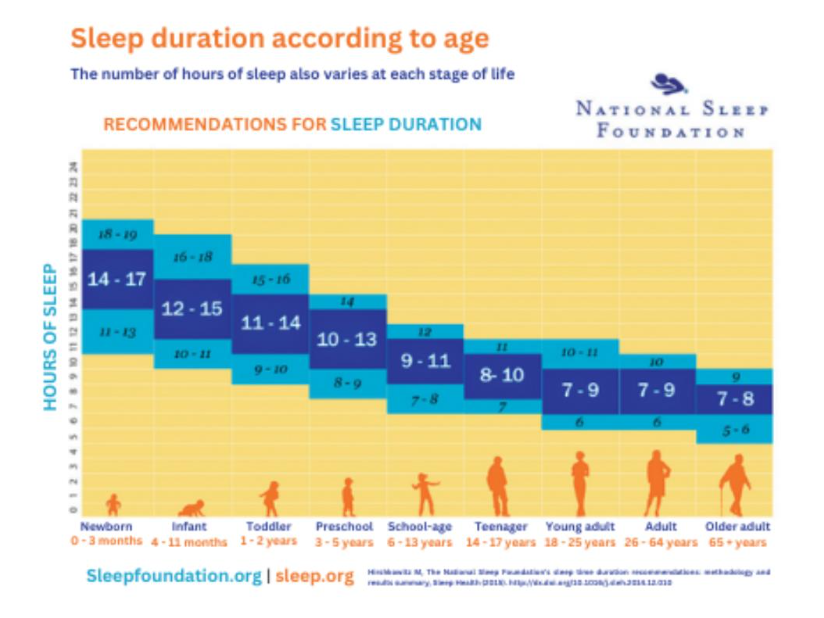
Another point is that people have different needs: some are early risers, who sleep and wake up early, while others are evening types, who can only sleep later and need to wake up later. She emphasizes that each person needs to understand their sleep characteristics to reach adequate rest. Furthermore, different life stages change the amount of sleep needed.
A chart by the National Sleep Foundation shows that the need for hours of sleep decreases over a lifetime: for a newborn, 14 to 17 hours of sleep are needed, whereas for an elderly person, the number drops to 7 to 8.
While a variety of factors can influence sleep quality, sleep hygiene is one alternative that helps promote proper rest. Maria highlights that these are recommendations, not absolute truths. Measures to improve sleep include:
• Avoiding alcohol and caffeine before bedtime;
• Going to bed only when feeling sleepy;
• Scheduling fixed times for sleeping and waking up;
• Reducing light and screen stimuli;
• Sleeping in the dark.
Sleep hygiene is part of the postdoctoral research in Epidemiology developed by Fabiana Carvalho at UFRGS. In her study, Fabiana created informative materials about sleep hygiene and tips for better sleep.
Video on sleep hygiene tips produced by Fabiana Carvalho for her postdoctoral research in Epidemiology at UFRGS.
Night, Darkness, and Melatonin
In October 2021, ANVISA approved the use of melatonin as a dietary supplement with a maximum daily dose of 0.21 mg. Melatonin is a hormone naturally produced in various parts of the body, and the supplement became popular as a way to help with sleep, being seen as “natural” and “non-addictive.”
Fernanda Amaral, a researcher at the Federal University of the State of São Paulo (UNIFESP), has studied melatonin and the pineal gland since her undergraduate studies. She explains that various organs produce the hormone for their own use as an antioxidant (neutralizing free radicals). This includes the skin, which needs to neutralize the radicals produced by sun exposure.
The main source of melatonin in the body is the pineal gland, which signals to the entire body the transition from day to night. As darkness falls, the pineal gland produces melatonin, which is carried through the bloodstream to the body and brain, signaling that rest time is approaching, allowing organs to reduce their functions. In other words, melatonin signals to the body that it should prepare for sleep.
Melatonin is only produced in the pineal gland when it’s dark. As night falls, the amount of melatonin in the body increases; when morning comes, it decreases. Therefore, artificial lights, such as those from lamps and electronic devices, delay the start of melatonin production and impact sleep quality.
Without proper rest, the body starts to weaken. Over time, this increases the chances of health problems, such as tumors, psychiatric disorders, and metabolic energy issues (such as heart and brain vascular accidents).
Fernanda stresses that the solution is not supplementing with melatonin, as improper doses or timing can disrupt the body’s natural rhythm. “The best source of melatonin is your pineal gland,” she emphasizes. Reducing light as night falls, using yellow lights in rest areas, and activating blue light filters on electronic devices [as blue light inhibits melatonin production], is recommended to stimulate melatonin production.
Melatonin can help patients with sleep disorders, but only in specific cases. It’s necessary to investigate the cause, as sleep disorders can have psychological, neurological, respiratory, or even dental origins.
Respiratory Disorders: Obstructive Sleep Apnea
Almost everyone has someone in their family who snores when asleep. Snoring is caused by air passing through a narrowed respiratory space, condition that can disrupt sleep, leading to fatigue and tiredness. It is also a symptom of obstructive sleep apnea (OSA), although not everyone who snores has sleep apnea.
In OSA, airflow is partially or completely blocked due to collapse of the upper airways. As a result, snoring occurs, followed by occasional breathing pauses which cause the person to wake up repeatedly throughout the night. Other symptoms include choking, feeling of suffocation, restlessness, palpitations, nightmares, and more.
OSA can vary in “intensity.” Besides affecting sleep quality, it increases the risk of cardiovascular, metabolic, and neurocognitive diseases, such as hypertension, stroke, cardiac arrhythmia, and type 2 diabetes.
According to pulmonologist and sleep medicine specialist Ângela John, from the Porto Alegre Clinical Hospital, treatment should be individualized according to the patient’s needs. Available in some municipal and state health programs and in the private sector, the approach can include behavioral measures, medications, speech therapy, or devices to open the jaw or keep the airways separated (positive pressure equipment).

Do You Grind Your Teeth?
Another condition that affects rest is sleep bruxism, characterized by increased chewing muscle activity. A person with bruxism clenches, grinds, rubs, or pops their teeth or jaw, which causes pain often confused with headaches or earaches.
Karen Chaves, a professor at the UFRGS School of Dentistry, explains that bruxism can occur during the day, and teeth should only touch when chewing. In such cases, it’s necessary to be mindful of avoiding tension. Not all episodes of bruxism are audible, so it’s important to watch for pain with a “set time,” such as always having pain upon waking, or after a stressful activity.
Bruxism has no cure and is related to stress. Treatments with speech therapists and physiotherapists, along with using a night guard, can reduce symptoms. Some psychopharmacological drugs can cause bruxism; in such cases, the recommendation is to adjust the medication or use treatments for bruxism alongside it.
The community outreach project ATM Without Restrictions, promoted by the School of Dentistry, provides internal and external services on the topic. Currently, the following activities are carried out:
- S.O.S. TMD: Offers support to UFRGS students with bruxism and temporomandibular disorders (TMD). Registration for services is available through the link to the form.
- Voice Connection: Provides care for transgender patients with mastication dysfunctions and bruxism.
- School Connection: Educates students from public schools about bruxism and harmful habits affecting the masticatory system.
- Knowledge in TMD: Offers multidisciplinary guidance on masticatory system dysfunctions to the community.
For more information, visit the project’s Instagram: @atm_sem_restricoes
The Pandemic’s Consequences
Health professionals interviewed for the report emphasize that anxiety and stress are among the main factors aggravating sleep disorders. These levels increased during the pandemic and have not decreased.
It’s noticeable that lack of sleep makes people irritable, and in search of a quick fix, they turn to medications. However, drugs often interfere with sleep stages, impacting the quality of rest. It’s necessary to investigate and properly treat what is hindering an individual’s rest—medications may be an option, but they are not always the best solution. Each case should be individually assessed by a health professional.
Ivan has been in treatment for almost twenty years and states that the process “is an adult life decision” for better quality of life. Reflecting on the anxiety he suffered because of the syndrome, he explains: “It’s never just about not being able to sleep; there’s an avalanche of consequences to that.”
Translated into English by Lucas Eduardo Camargo, undergraduate student enrolled in the course “Supervised Translation Training II (English)” of the Undergraduate Program in Language and Literature, under the supervision and translation revision of Professor Elizamari R. Becker (P.h.D.) – IL/UFRGS.