
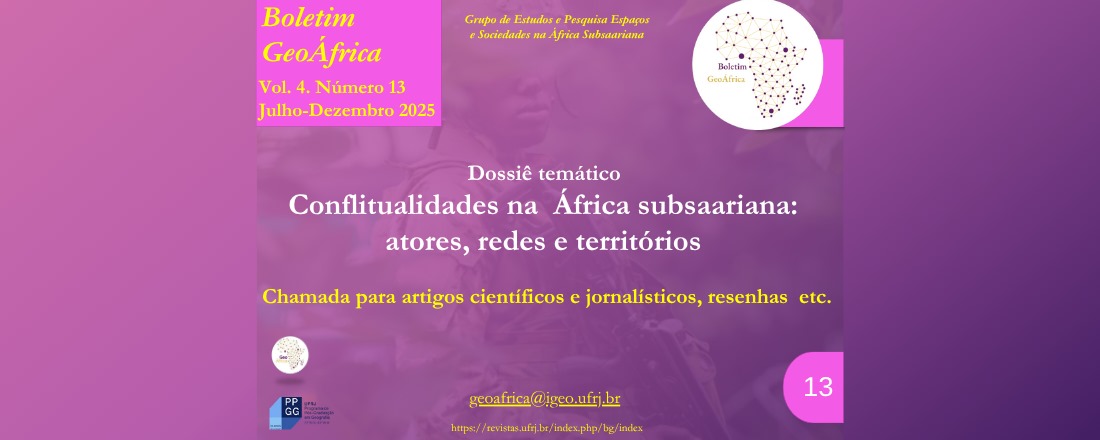
“Call for Papers
GeoÁfrica Bulletin v. 4, n. 13, July-December 2025
Thematic Dossier:
Conflicts in Sub-Saharan Africa: Actors, Networks, and Territories
Sub-Saharan Africa is a region particularly exposed to armed conflicts. Wars, which have affected almost all countries to varying degrees, are estimated to have claimed the lives of approximately 10 million people since the 1960s. Since the 1990s, there has been a resurgence of armed conflict. In 2022, armed conflicts and lethal political violence were recorded in 22 countries. This phenomenon contributes to the image of a “naturally violent” continent, which, after being used to justify the “civilizing mission” of the white man and European colonization, has entered the gallery of essentialist and prejudiced representations of Africa. Today, conflicts are still often described as ethnic, bloody, barbaric, terrorist, etc., through reductive assessments that minimize the complexity of their causes, characteristics, and impacts. However, for decades, the nature of the belligerents’ objectives has given clearly defined operational and narrative contours to African conflicts. The actors in national liberation wars, secessionist tensions, or armed confrontations related to the Cold War essentially sought to exert political control over a specific territory. But, starting in the 1990s, the so-called new conflicts are characterized by the lack of clear starting and ending points and a territorialization marked by spatial diffusion and internationalization of operations. More recently, conflict has become more multifaceted. The effects of climate change, political and geopolitical instability, social and economic crises, and demographic factors have added complexity to the conflicts. The precarious control of the state over territories and the degradation of public services fuel insurgencies with multiple actors involved.
The Editorial Board of the GeoÁfrica Bulletin has decided to dedicate a thematic dossier to contemporary conflicts in Sub-Saharan Africa, focusing on specific regions (Sahel, Great Lakes, Northern Mozambique, Horn of Africa, etc.) and topics such as secessionism; natural resources and conflicts; terrorist group activism; climate change and land use conflicts; foreign interventions; refugees and displaced persons; peace operations; territories and territorialities of conflict, etc. GeoÁfrica Bulletin is accepting submissions of scientific articles, journalistic pieces, interviews, image analyses, etc., until November 9, 2025, through our platform (https://revistas.ufrj.br/index.php/bg/index) or by email: geoafrica@igeo.ufrj.br. We also welcome articles on various topics for our “Varia” section.
Manuscripts in French (and English) are also accepted. If these articles have been previously published and remain relevant, we may publish their translations.”
Read more here
